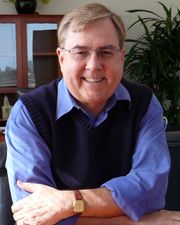
Lawrence A. Rowe
(BIOGRAPHY)
Emeritus Professor,
Electrical Engineering and Computer Science
University of California, Berkeley
President,
FX Palo Alto Research Laboratories
Biographical Information
Professor Lawrence A. Rowe retired from the University in
June 2003 after twenty-seven
years to pursue projects involving the development of streaming media
software, consulting with multimedia research laboratories, and
investing in startup companies.
He was the founding director of the Berkeley Multimedia
Research Center (BMRC), which was created in 1995 to
explore the application of multimedia technology including streaming
media and web-based interactive titles to education and research.
BMRC taught classes on multimedia authoring, established and operated
authoring studios and distributed collaboration and distance learning
rooms and services, and provided advice and technical support on a wide range
of issues relating to multimedia authoring and distributed collaboration.
BMRC closed in 2002 due to a lack of funding and support.
Professor Rowe headed the research group that produced
the Berkeley MPEG-1 Tools (1991-5), the Berkeley Multimedia,
Interfaces, and Graphics (MIG) Seminar Internet webcast (1995-2002), and
the Open Mash Streaming Media Toolkit (1999-2003). Rowe was also
responsible for the development and deployment of the Berkeley
lecture webcasting system.
Earlier in his career he worked on database application
development tools and technologies that were later
commercialized by Ingres Corporation.
He served as President and later CEO of FX Palo Alto Research
Laboratories (FXPAL) from 2007-2014. FXPAL was a small multimedia
research laboratory co-owned by Fuji
Xerox and Xerox Corporation. The primary research directions of the lab were
interactive multimedia document authoring, storage, and analysis and
mixed reality distributed collaboration.
Rowe received a BA degree in Mathematics and a PhD in
Information and Computer Science from the University of California at
Irvine in 1970 and 1976, respectively.
He is a Fellow of the ACM, past chair of the ACM Special Interest Group
on Multimedia, and has served on many governmental advisory committees.
Professor Rowe has consulted with and served on the Technical Adivsory
Boards of numerous companies, co-founded several companies including
Ingres Corporation, NCast Corporation, and Orinda Software, Inc., and
served on the Board of Directors of Ingres Corporation, NCast Corporation,
and Siemens Technology-to-Business.
Contact Information
I have given up my office at Berkeley, so the best way to contact me is
by email through my Berkeley accounts
(email address: larry.rowe at the gmail "dot" com host)
or by phone (925-218-2221).
Miscellaneous Information
-
The BMRC website no longer exists. Most of the titles, including
the streaming media lectures are no longer operational. Archives of
selected past class websites, project descriptions, publications,
instructional guides, and software may not be available.
-
The NOSSDAV '05 Workshop website contained streaming media of all talks and
panel sessions at the workshop.
This material was captured as part of an experiment in low cost lecture
capture for professional conferences. A paper describing the technology,
cost, and content is available through the website.
- Open Mash Streaming Media Toolkit -
Several people, including me, continue to develop the
Open Mash Streaming Media Toolkit created by Steve McCanne
when he was on the Berkeley faculty.
The Open Mash website, the source management and distribution system,
and the various mailing lists continue to operate. See the website
for recent announcements about new features added to the system.
We are currently working to produce a stable Version 5.3 general release.
- Berkeley MPEG-1 Video Tools -
We developed the tools back
in the early 1990's to assess the suitable of desktop
computers for software encoding and decoding MPEG video. These
tools included the first widely distributed MPEG-1 video decoder
(mpeg_play), encoder (mpeg_encode), and several tools to
analyze how a particular video was encoded. We do not support these tools,
but they continue to be popular for reasons at which I can only guess.
Most desktop systems have better players and encoders available, but you
are welcome to do with the code whatever you want. We published several
papers describing the software including benchmarks on systems available
at the time and later completed a paper that compared the software released
in 1993 with the same software running on a 2005 computer that
appeared in the first issue of
the new ACM Transactions on
Multimedia Computing, Communications, and Applications.
- Berkeley Lecture Webcasts (BIBS System) -
We began regularly schedule webcasts of the
Berkeley MIG Seminar
in January 1995 and continued every week through December 2002 except for
Academic Year 2001-2 when I was on sabbatical. We still have all the video
tapes and the digitized lectures. I am hoping at some point in the future
to produce a DVD with the "greatest hits" lectures from the series.
Sadly, both the MIG Seminar and the class lectures we produced with the
Berkeley Internet Broadcasting System (BIBS) from Fall 1998 semester
through the Spring 2001 semester are no longer accessible. The software
used several servers (see the
BIBS Report for a
description of the system architecture), and it is too difficult to keep
them running with all the maintenance required in our modern spam and virus
infested Internet.
The system was transfered to
Educational Technology Services,
which is a campus support organization on the Berkeley campus.
You can view recent lectures at their website at
http://webcast.berkeley.edu/
- The following links might be useful:
- Curriculm Vitae
- Publications
- Talks
- Masters
and PhD
students and past
industrial visitors
- Course Websites
-
Since retiring I have read a number of interesting books on technology
topics, particularly telecommunications and broadcasting, and on investing
and current and historical events.
Here's a
reading list
with comments.
-
The Computer History Museum did an oral history about my career with
a focus on the founding and history of the INGRES RDBMS first
developed at U.C. Berkeley.
Here is a link Oral History.
Last modified: July 18, 2024